
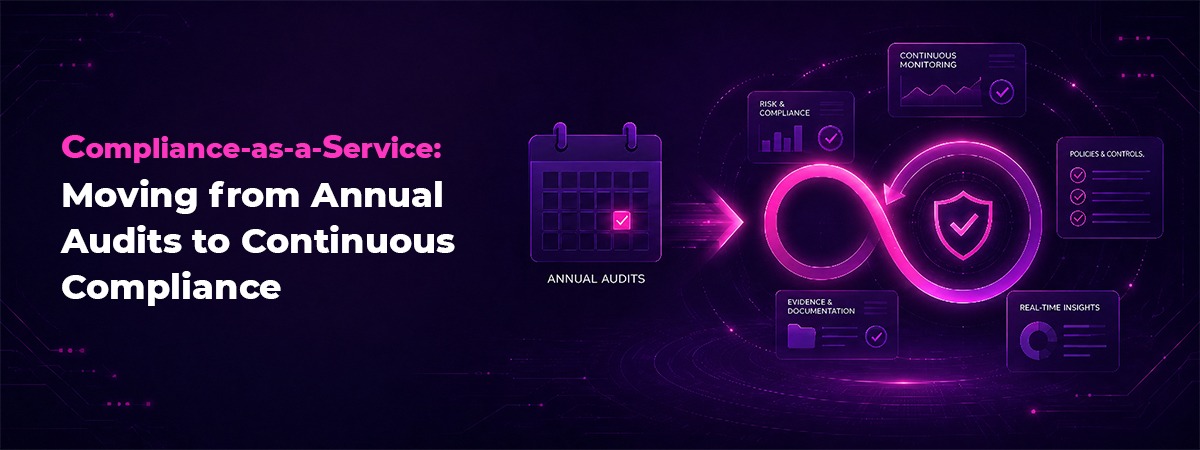
For many organisations, compliance still follows a familiar cycle.
- An audit approaches.
- Policies are reviewed.
- Evidence is collected.
- Risk registers are updated.
- Control owners are contacted.
- Gaps are remediated, often under significant time pressure.
Then the audit is completed, and compliance activity gradually slows down until the next assessment.
But today’s regulatory and cybersecurity environment is making this approach increasingly difficult to sustain.
Regulations change. Technology environments change. Vendors change. Business processes change. And risks change continuously.
This is driving organisations toward a more continuous approach to governance, risk, and compliance: Compliance-as-a-Service (CaaS).
Rather than treating compliance as a one-time certification or annual audit exercise, CaaS provides an ongoing framework for assessing risks, managing controls, maintaining evidence, tracking remediation, and staying prepared for regulatory scrutiny.
Why the Traditional Compliance Model Is Under Pressure
The compliance landscape has become considerably more complex.
Organisations may need to address multiple frameworks and regulations simultaneously, including:
- ISO 27001
- SOC 2
- PCI DSS
- NIST
- CERT-In requirements
- Digital Personal Data Protection (DPDP) requirements
- RBI and SEBI requirements
- Industry-specific regulations
- Emerging AI governance requirements
The challenge isn’t simply understanding these frameworks.
The bigger challenge is operationalising them.
A policy may say one thing while the actual technology environment does another. A control may exist but not be monitored. A vendor assessment may have been completed six months ago even though the vendor’s risk profile has changed.
This creates a gap between documented compliance and actual compliance maturity.
PwC’s 2026 Global Digital Trust Insights survey, covering 3,887 business and technology executives across 72 countries, illustrates the point. Roughly half of respondents said their organisation was at best only “somewhat capable” of withstanding cyber attacks targeting specific vulnerabilities, and only 6% felt confident across all vulnerabilities surveyed. Only 24% reported spending significantly more on proactive measures, “monitoring, assessments, testing and controls”, than on reactive ones such as incident response, fines and recovery.
The message is clear: most organisations are still budgeting to respond after the fact rather than to maintain readiness before it.
What Is Compliance-as-a-Service?
Compliance-as-a-Service is a managed approach to governance, risk and compliance in which an organisation receives ongoing support to assess, implement, monitor and improve its compliance posture.
Instead of engaging a consultant only when certification or an audit is approaching, organisations can maintain a continuous compliance programme.
A typical CaaS lifecycle can be represented as:
Assess → Remediate → Implement → Monitor → Assure
1. Assess
Understand the organisation’s current compliance posture.
This can include:
- Compliance gap assessments
- Risk assessments
- Control assessments
- Policy reviews
- Regulatory applicability assessments
- Third-party risk assessments
2. Remediate
Identify gaps and establish a structured remediation programme.
This involves:
- Prioritising findings
- Assigning control owners
- Setting remediation timelines
- Tracking corrective actions
- Managing exceptions
3. Implement
Translate compliance requirements into operational controls.
For example, a requirement around access management should ultimately translate into actual processes and technologies such as:
Requirement → Control → Process → Technology → Evidence
This is where compliance starts becoming part of day-to-day operations rather than remaining a documentation exercise.
4. Monitor
Compliance doesn’t stop after controls are implemented.
Organisations need ongoing visibility into:
- Control effectiveness
- Risk changes
- Policy compliance
- Vendor risk
- Regulatory changes
- Evidence status
- Open remediation items
5. Assure
Finally, organisations need to be able to demonstrate that controls are working.
That means maintaining:
- Audit evidence
- Compliance reports
- Risk registers
- Control documentation
- Management reviews
- Remediation records
- Audit readiness
The objective is simple:
When the auditor arrives, the organisation shouldn’t have to start preparing.
It should already be prepared.
Why this matters more in India right now
Indian organisations face a specific convergence that makes the continuous model less optional than it might appear elsewhere.
Most regulated entities here are already subject to multiple overlapping regimes. A financial services firm may answer to the RBI Cyber Security Framework, SEBI’s CSCSF, CERT-In directions, and hold ISO 27001, each with its own evidence expectations, each phrasing broadly similar controls in different language. Insurers add IRDAI. Anyone touching Aadhaar adds UIDAI requirements.
The Digital Personal Data Protection Act now layers on top of all of it. The DPDP Rules were notified in November 2025 with a phased rollout: the Consent Manager framework under Rule 4 becomes operational on 13 November 2026, and full substantive compliance “notice, consent, security safeguards, breach reporting, data principal rights” is due by 13 May 2027. Penalties reach ₹250 crore per violation.
Readiness is not where it needs to be. EY India’s report India’s digital privacy crossroads, based on a survey of nearly 150 professionals across sectors, found that close to 70% of respondents had limited understanding of the Act and its Rules. Around 48% had initiated gap assessments “the most common first step”, but only about 44% had progressed to documenting data processing procedures and roughly 38% had begun categorising personal data. Nearly 81% had not updated or drafted DPDP-aligned privacy policies or governance frameworks, and over 83% had not initiated end-to-end implementation across systems and processes.
Sector variation is stark. Consumer, retail and e-commerce lead at 50% having begun the DPDP journey, followed by technology services at 38.8% and financial services at 34.7%. Metals, mining and energy sit at 20%, and healthcare and life sciences at just 9.9%.
Run those obligations as four or five separate annual programmes and the cost compounds, not linearly, but through duplicated evidence work, conflicting remediation priorities, and repeated rediscovery of the same environment. A unified control library maintained continuously is materially cheaper than five parallel point-in-time exercises, and it is the only practical way to answer a regulator who asks about a control on a date you did not choose.
Why Continuous Compliance Matters
1. Regulations Don’t Stand Still.
Compliance requirements increasingly evolve alongside technology and business models. India’s DPDP framework is a case in point: knowing that a regulation exists is not the same as being operationally prepared for it, as the EY readiness figures above make clear.
CaaS helps organisations continuously translate regulatory requirements into controls, responsibilities and measurable actions.
2. Risk Changes Faster Than Audit Cycles
A vendor that was low-risk six months ago may now have access to more sensitive data.
A cloud workload may have changed.
A new application may have been deployed.
A new AI tool may have been introduced into the business.
A critical control may no longer be operating effectively.
An annual assessment can identify these issues but potentially only after they have existed for months.
Continuous compliance creates a mechanism to identify and address such changes earlier.
3. Evidence Collection Shouldn’t Be a Last-Minute Exercise
One of the most common compliance challenges is not necessarily the absence of controls.
It is the inability to prove that those controls are operating effectively.
Evidence can become fragmented across:
- Emails
- Spreadsheets
- Ticketing systems
- Cloud platforms
- Security tools
- HR systems
- Vendor portals
- Individual control owners
By the time an audit begins, teams may spend weeks trying to reconstruct evidence.
A managed CaaS approach establishes an ongoing process for collecting, validating and maintaining evidence.
Compliance Is Becoming More Connected to Cybersecurity
Compliance and cybersecurity are often treated as separate functions.
In reality, they increasingly overlap.
Consider a requirement for privileged access management.
Compliance asks:
Is there an appropriate control ?
Cybersecurity asks:
Is the control actually protecting the environment ?
Effective compliance needs both answers.
This is why modern compliance programmes increasingly connect:
Governance + Risk + Compliance + Security Controls + Evidence
Compliance therefore cannot exist entirely as a documentation function.
It needs to connect with the organisation’s actual security and risk posture.
The Rise of AI Governance
AI is creating another layer of compliance and governance complexity.
Organisations are rapidly adopting generative AI and other AI technologies, but governance mechanisms are not necessarily keeping pace.
IBM’s 2025 Cost of a Data Breach research found that 63% of organisations globally lacked AI governance policies to manage AI or prevent shadow AI, while 97% of organisations that reported an AI-related security incident lacked proper AI access controls.
In India, IBM reported that nearly 60% of organisations either did not have AI governance policies or were still developing them, and only 37% reported having AI access controls in place.
This creates an emerging opportunity for AI Governance-as-a-Service, covering areas such as:
- AI inventor
- AI risk assessments
- Shadow AI governance
- AI policies
- Data governance
- Access controls
- Third-party AI risk
- AI compliance monitoring
- Governance reporting
For organisations adopting AI at scale, governance needs to evolve alongside adoption.
What Can Compliance-as-a-Service Cover?
A mature CaaS programme can extend beyond certification support.
Governance
- Security and compliance policies
- Governance frameworks
- Roles and responsibilities
- Management reviews
- Compliance reporting
Risk Management
- Enterprise risk assessments
- Cyber risk assessments
- Risk registers
- Risk treatment plans
- Third-party risk
- Risk monitoring
Compliance
- ISO 27001
- SOC 2
- PCI DSS
- NIST
- DPDP
- CERT-In
- Sector-specific regulations
- Other applicable frameworks
Control Management
- Control design
- Control implementation
- Control testing
- Control effectiveness reviews
- Control mapping across frameworks
Audit Readiness
- Evidence management
- Audit preparation
- Finding management
- Corrective action tracking
- Certification support
Continuous Assurance
- Ongoing compliance reviews
- Risk monitoring
- Regulatory change tracking
- Control monitoring
- Compliance dashboards
- Management reporting
CaaS vs Traditional Compliance Consulting
The difference is primarily in continuity and ownership.
| Traditional Consulting | Compliance-as-a-Service | |
|---|---|---|
| Engagement model | Project-based | Continuous |
| Primary driver | Often audit-driven | Risk-driven |
| Assessment cadence | Periodic | Ongoing |
| Evidence | Collected for audits | Maintained continuously |
| Remediation | Project-based | Continuously tracked |
| Framework approach | Framework-specific | Consolidates multiple frameworks |
| Post-audit engagement | Limited | Ongoing governance and assurance |
Traditional consulting still has its place, particularly for organisations beginning a certification journey. But organisations with complex environments increasingly need something beyond a one-time assessment.
They need an ongoing compliance capability.
The Business Case for CaaS
The value of Compliance-as-a-Service isn’t simply about passing an audit.
A well-designed CaaS programme can help organisations:
Reduce compliance overhead
Standardised processes reduce repetitive manual work around assessments and evidence collection.
Improve risk visibility
Management gets a clearer view of open risks, control gaps and remediation status.
Strengthen audit readiness
Evidence and documentation are maintained continuously instead of being reconstructed before an audit.
Reduce regulatory exposure
Organisations can identify compliance gaps earlier and respond to regulatory changes more systematically.
Improve customer and partner trust
Demonstrable compliance can support customer due diligence, vendor onboarding and business relationships.
Connect compliance with cybersecurity
Controls can be evaluated not just for their existence but for their effectiveness in managing actual cyber risk.
How SecForge Approaches Compliance-as-a-Service
At SecForge, Compliance-as-a-Service is positioned as an ongoing approach to cybersecurity governance, risk, and compliance.
Rather than treating compliance as a certification exercise, the focus is on helping organisations establish a continuous compliance lifecycle.
This can include:
Assess
Understand regulatory requirements, risks and current control maturity.
Remediate
Prioritise gaps and track corrective actions.
Implement
Translate compliance requirements into practical policies, processes and controls.
Monitor
Maintain visibility into risks, controls, evidence and regulatory changes.
Assure
Provide ongoing readiness, reporting and governance support.
This approach helps organisations move from:
“Are we ready for the audit?” to: “How confident are we in our compliance posture today?”
The Future of Compliance Is Continuous
Compliance is becoming more dynamic.
New regulations are emerging. AI is changing business processes. Third-party ecosystems are expanding. Cloud environments are constantly changing. Cyber risks continue to evolve.
In this environment, an annual compliance exercise cannot provide continuous assurance.
The organisations that build stronger compliance programmes will be those that integrate compliance into everyday risk and security operations.
Compliance-as-a-Service provides a way to make that shift.
From annual audits to continuous compliance. From checklists to controls. From documentation to evidence. And ultimately, from being compliant to staying compliant.